

The Sustainable Aviation Test Environment (SATE), part of the UKRI Future Flight Challenge, established the UK’s first operationally based low-carbon aviation test centre, based at Kirkwall Airport on Orkney. Led by the Highlands and Islands Transport Partnership (HITRANS), SATE brings together a national consortium of industry partners, public sector bodies and academia which work with a range of regional businesses and stakeholders to apply state-of-the-art aviation technology to deliver targeted economic growth.
While the original SATE facilities are based at Kirkwall Airport, SATE works across several Highlands & Islands communities, matching emerging aviation technologies with practical use cases to benefit the region.
Since its launch in November 2020, SATE has secured successive rounds of Innovate UK funding, reflecting the programme’s continued growth and impact. The project began under Future Flight Challenge Phase 2 (SATE 1), establishing the test environment and delivering landmark early demonstrations including hybrid-electric flight and autonomous drone logistics. This was followed by Future Flight Challenge Phase 3 (SATE 2), which deepened technical capabilities and expanded use cases across the region.
The SATE Regional Demonstrator and Strategic Growth projects, the Highlands and Islands Regional Pathway to Sustainable Aviation and ALBUM (Advanced Logistics BVLOS UAV Mission), both concluded in March 2026. These projects delivered important advances in regional aviation strategy, commercial opportunities and autonomous drone logistics, building the foundations for the next phase of sustainable aviation development.
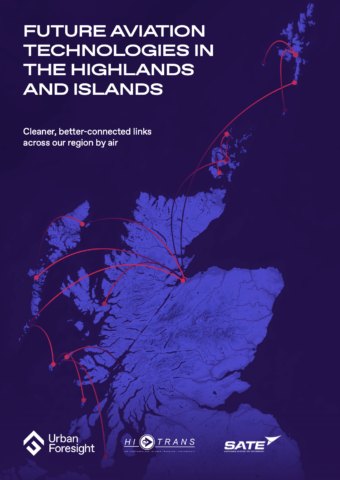
Read the 10 year future aviation roadmap here.
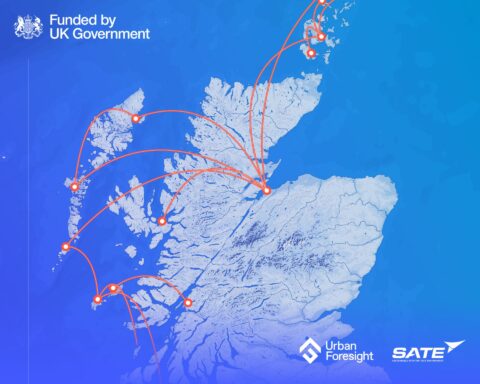
SATE’s work continues through the Hydrogen Roadmap, an 18-month feasibility study supported by £190,081 from the Department for Transport’s Zero Emission Flight Demonstrator competition. Led by Urban Foresight in partnership with HITRANS, EA Maven, Cormorant Seaplanes and Hybrid Air Vehicles, the project will establish how and where hydrogen-powered aircraft could first enter service on regional routes across the Highlands and Islands.
The Hydrogen Roadmap will develop a region-specific strategy, identifying commercially viable routes, infrastructure requirements and the potential environmental, economic and social benefits of hydrogen aviation. HITRANS will lead stakeholder engagement, communications and exploitation of the project’s outputs, helping to translate SATE’s innovation and testing experience into a practical pathway towards future zero-emission regional air services.
Alongside the Hydrogen Roadmap, SATE is supporting Project SEAN (Scottish Electric Aviation Network), a collaborative initiative exploring the potential of electric aircraft to deliver sustainable regional air services across the Highlands and Islands. Led by Bristow Helicopters Ltd., the project will demonstrate BETA Technologies’ all-electric ALIA CTOL aircraft on regional routes, including Inverness to Wick, while developing charging infrastructure and gathering real-world evidence to support the future deployment of electric aviation. HITRANS will contribute its expertise in sustainable aviation innovation and regional connectivity, helping to translate the project’s findings into practical opportunities for the region.